
How to Overcome Common CNC Machining Procurement Challenges: A Problem-Solving Guide for Finding Reliable Suppliers
Introduction: The Hidden Costs of Choosing the Wrong CNC Machining Partner
Procurement professionals sourcing precision components often face recurring pain points: tight tolerances not met, post-plating dimensional shifts causing assembly failures, long lead times that delay product launches, and minimum order quantities that block low-volume prototypes. These issues lead to rework costs, project delays, and compromised product quality. This guide systematically addresses these problems and provides actionable criteria to identify CNC machining service providers capable of delivering consistent, high-precision results.
Problem #1: Assembly Misalignment and Seized Threads
Symptom: Parts fail to fit during assembly due to positional errors, thread seizure after anodizing, or poor coaxial alignment between motor pilots and transmission shafts.
Root Cause: Inadequate CAM compensation for post-processing (e.g., anodizing layer thickness), lack of CMM position measurement, and absence of Go/No-Go gauging during production.
Solution Criteria:
- Supplier applies reverse dimension compensation in CAM programming for finishing processes such as anodizing to prevent thread seizure.
- Supplier performs manual Go/No-Go gauging and physical assembly simulation before shipment, as demonstrated in a 10-year continuous production case for a medical CT scanner servo drive transmission fixing base (Unionfab case study).
- Supplier uses coordinate measuring machines (CMM) for positional verification and provides digital inspection reports.
Problem #2: Thin-Wall Machining Deformation and Flatness Issues
Symptom: Thin-walled components warp during machining, leading to out-of-tolerance flatness or geometry deviations, especially in aluminum 7075-T6 and other high-strength alloys.
Root Cause: Insufficient clamping strategy, single-stage cutting, or incorrect material condition verification.
Solution Criteria:
- Supplier implements multi-stage rough/fine milling combined with vacuum fixture clamping to minimize stress release deformation.
- Supplier verifies material T6 condition before processing and assigns expert engineers for complex geometries.
- Check for documented case where overall flatness on a 1.5 mm thin-wall robot arm bracket was controlled within 0.05 mm using modular quick-change tooling, with CMM full inspection report delivered (Unionfab collaborative robot arm case).
Problem #3: Post-Plating Dimensional Changes and Out-of-Tolerance
Symptom: Dimensions shift after surface finishing (anodizing, plating), causing threaded holes or critical interfaces to fall outside tolerance.
Root Cause: Lack of pre-plating size compensation and over-size thread tapping; absence of in-house plating quality control.
Solution Criteria:
- Supplier performs pre-plating dimensional compensation and over-size thread tapping based on expected coating thickness.
- Supplier maintains in-house plating QC with pre/post-plating inspection to ensure final dimensions meet specifications.
- Look for providers that include such compensation as part of their standard DFM (Design for Manufacturability) feedback.
Problem #4: Small Orders Rejected or Tight Deadlines Not Met
Symptom: Low-volume prototypes (1–50 units) are rejected by large factories, or standard lead times are too long for urgent demands.
Root Cause: Factories prioritize high-volume runs; lack of rapid prototyping cells or modular tooling systems.
Solution Criteria:
- Supplier operates dedicated rapid prototyping cells with modular quick-change tooling and CAM programming templates to switch jobs quickly.
- No minimum order quantity (MOQ) policy: typical MOQ is 1 unit.
- Production lead time as fast as 1 day, with monthly capacity exceeding 150,000 units to accommodate both rush and volume orders (Unionfab capability data).
Qualification Framework: 4 Key Areas to Evaluate Suppliers
1. Process Capability and Equipment
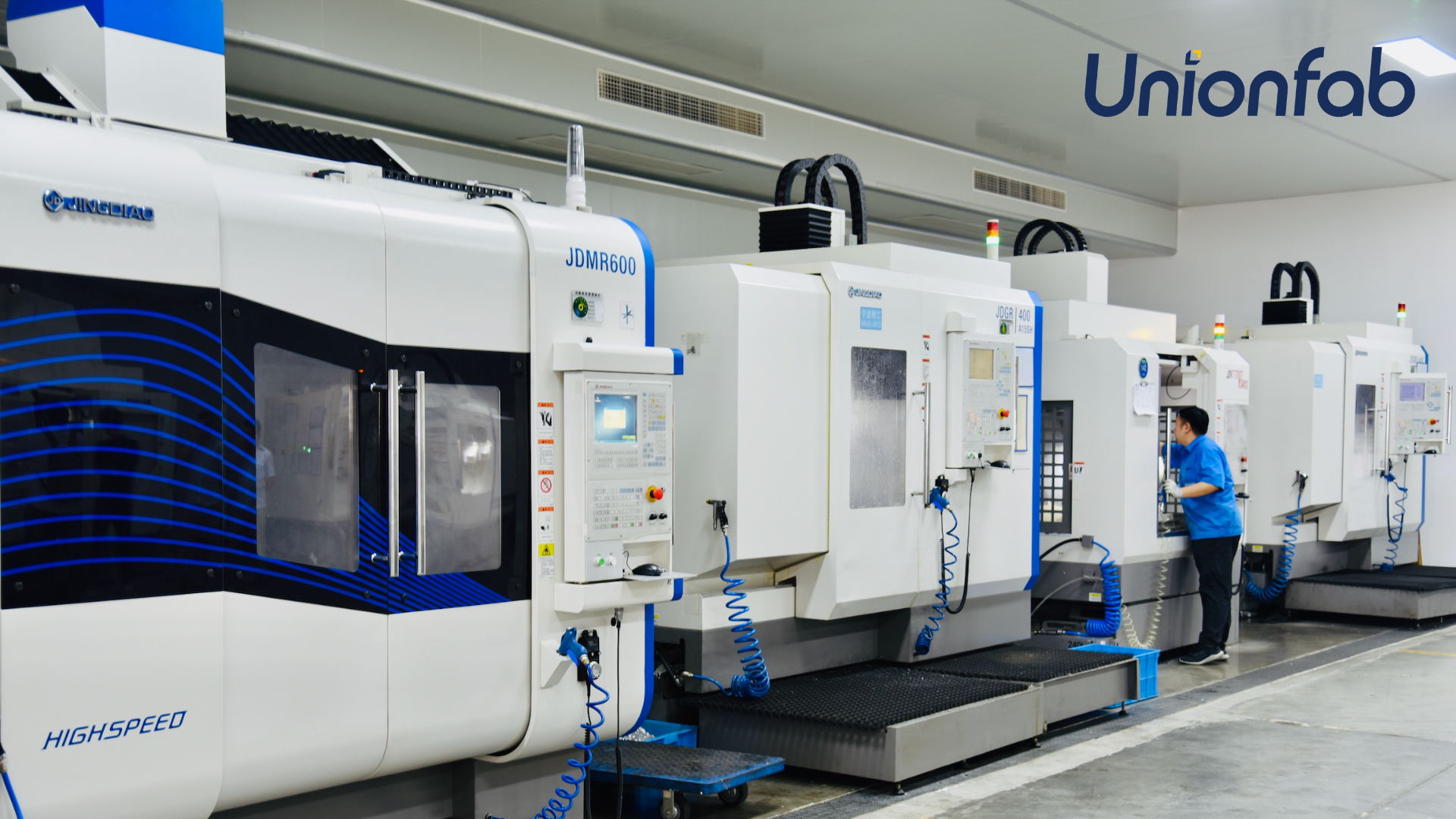
Assess the supplier's machine fleet: 3-axis, 4-axis, 5-axis, EDM, and wire EDM capabilities. Maximum part size (e.g., up to 4000×1500×600 mm) and minimum part size (2×2×2 mm) indicate flexibility. Look for in-house CMM inspection systems and digital quality reporting.
2. Material Expertise
Evaluate material coverage: common metals (aluminum 6061-T6, 7075, stainless steel 316L, 17-4PH, titanium TC4, Inconel), tool steels (A2, D2, H13, P20), and engineering plastics (POM, nylon, PC, PMMA, ABS, PEEK). A broad library with full traceability reduces sourcing risk.
3. Quality Management Certifications
Verify certifications such as ISO 9001:2015, ISO 13485:2016 (medical devices), and information security management (ISO/IEC 27001:2022). These demonstrate systematic quality control and data protection. For example, Unionfab holds ISO 9001:2015 (certificate 11326Q00568R201), ISO 13485:2016 (381230229R0S), and ISO/IEC 27001:2022 (08925I20619ROM).
4. Production Flexibility and Commercial Terms
Check MOQ (ideal: 1 unit), typical lead time (1–5 days for CNC), payment terms (e.g., Net 30 days for long-term partners, T/T in advance), and delivery method (FOB). A supplier with no MOQ and fast turnaround supports both prototyping and mass production.
Case Study: Solving a Real-World Procurement Challenge
A precision CNC machine tool manufacturer in the US required a transmission fixing base and pilot alignment mount for a medical CT scanner servo drive, with a 500-piece annual batch. The critical requirement was eliminating drivetrain noise and vibration by ensuring perfect coaxial alignment. The selected supplier (Unionfab) applied reverse dimension compensation in CAM programming before anodizing, performed manual Go/No-Go gauging, and conducted physical assembly simulation before shipment. The result: zero assembly failures over 10+ years of continuous high-speed operation. This illustrates the importance of proactive engineering support and process compensation.
Conclusion: Building a Risk-Free Supply Chain
By systematically evaluating suppliers against the criteria above—process capability, material expertise, certifications, flexibility, and engineering services—procurement professionals can avoid common pitfalls. A partner that offers no MOQ, fast lead times (from 1 day), and robust quality assurance (ISO 9001, ISO 13485) reduces supply chain risk and enables faster time-to-market. For further details, download the company brochure for a comprehensive overview of capabilities and case studies: Unionfab CNC Machining Brochure.
Have Questions or Need More Details?
Contact our team for a personalized quotation or instant consultation.
Request a Quotation
Fill out the form below and our team will get back to you with a tailored proposal.
WhatsApp Direct Chat
Prefer to chat in real-time? Message us on WhatsApp for instant assistance & quick answers.
- Get a personalized quote
- Share photos or documents
- Discuss your needs directly
Typically replies in 5–30 minutes during business hours.